Cesta Roman: History of Ancient Roman Roads
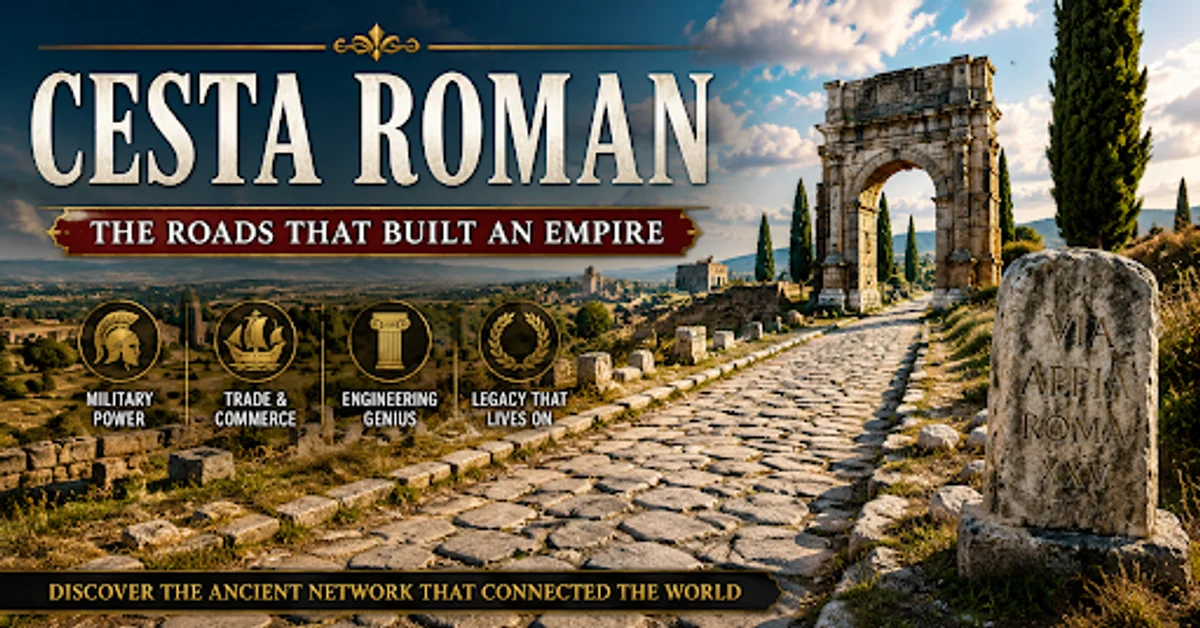
Cesta Roman is a modern phrase used online to describe the Roman roads that helped hold the Roman Empire together. The term is not a formal Latin expression, but it points to a real and powerful historical system: the road network that connected Rome to distant provinces, ports, forts, farms, and towns. In classical terms, historians usually refer to these routes as viae Romanae, or Roman roads.
The beauty of Cesta Roman is that it captures a simple truth. Roads were not just paths of travel. They were instruments of power, movement, and connection. They supported Roman transportation, military logistics, trade and commerce, and empire administration. From the first stone routes near Rome to long imperial highways crossing Europe, North Africa, and Asia Minor, the Roman road system became one of the greatest achievements in ancient engineering.
Read Also: Riverbank Collapse Iford Playing Fields: A Clear Guide
The History of Cesta Roman Roads
The story of Cesta Roman begins with ambition. As Rome grew from a city-state into a vast power, its leaders needed safer and faster ways to move soldiers, messages, and supplies. One of the earliest and most famous roads was the Via Appia, or Appian Way, begun in 312 BCE under Appius Claudius Caecus. It linked Rome to Capua and later reached farther south, becoming a model for Roman road construction.
Over time, the road network expanded with the empire itself. Under Julius Caesar, Augustus, Trajan, Hadrian, and later Constantine the Great, roads were extended, repaired, and reorganized to support military campaigns, communication, and trade. From Italy to Gaul, Britannia, Hispania, the Balkans, and beyond, Roman road history shows how infrastructure can shape civilization. These ancient roads were not built in a single moment. They grew step by step, along with the Roman Empire’s reach.
How Cesta Roman Roads Were Built
Roman road builders were practical, disciplined, and remarkably skilled. They did not rely on guesswork. Roman surveyors selected routes carefully, aiming for direct lines when terrain allowed, but adjusting for hills, marshes, rivers, and unstable ground. The result was a road system that balanced speed with durability. This is one reason Roman engineering still impresses historians today.
Many roads used layered road construction. Workers cleared the ground, built a strong base, and added layers of stone, gravel, and compacted materials. Some important roads were stone-paved roads; others were gravel roads or hardened earth roads. Drainage systems were essential, because water could quickly destroy a weak surface. Good road foundations, careful road maintenance, and sturdy Roman bridges helped the network last for centuries. These road engineering techniques were not identical everywhere, but they shared the same goal: reliable travel across a huge empire.
Types of Cesta Roman Roads
The Roman road system was not one single type of road. It was a flexible network shaped by purpose. Public roads connected major cities, markets, ports, and administrative centers. Military roads served forts, border zones, and supply lines, helping armies move quickly and maintain control. Local roads linked farms, villages, and smaller settlements to larger routes. Urban roads ran through Roman towns and city centers, guiding daily life, trade, and movement.
This variety made Roman road construction powerful. A local path in one region could be simple and narrow, while a major imperial route could be wide, carefully graded, and heavily maintained. Together, these roads formed a connected Roman highway network. They supported Roman infrastructure in a way that modern readers can still recognize: major arteries feeding smaller roads, all helping people move through a vast region with greater confidence and speed.
Key Features of the Cesta Roman Road System
Several features made Cesta Roman especially effective. The first was strength. Roman roads often began with a solid base of compacted earth and stone. The second was water control. Drainage systems allowed rain to run off the surface instead of pooling in the center. The third was connection across difficult terrain. Roman builders used bridges to cross rivers and valleys, turning natural barriers into manageable routes.
Another key feature was the Roman milestones placed beside important routes. These markers showed distance and often named the emperor or official responsible for the road. They helped travelers understand where they were and how far they still had to go. In many ways, milestones were the ancient world’s navigation system. Together with preserved routes, they give archaeologists valuable clues about historical travel, imperial transportation, and the spread of Roman civilization.
Famous Cesta Roman Routes Still Known Today
Some Roman roads became legendary because of their scale and importance. The Via Appia, or Appian Way, remains one of the most famous ancient highways in history. It began near Rome and stretched through Italy toward Capua and southern regions. The Via Flaminia connected Rome with northern Italy and the Adriatic Sea region, while the Via Augusta linked much of Hispania along the Mediterranean coast.
The Via Egnatia was equally important. It crossed the Balkans and connected the Adriatic region to the eastern provinces, making it a vital route for commerce, military movement, and regional control. These routes are more than names on a map. They are living evidence of Roman road builders at work. Today, many are studied as archaeological sites, heritage trails, and historical routes that reveal how the Roman road map shaped ancient travel across the Mediterranean Sea and inland provinces.
Why Cesta Roman Was Important to the Roman Empire
Cesta Roman mattered because it made the empire possible. Roman military roads allowed legions to move faster, reinforce borders, and support campaigns in distant places. When Trajan expanded Roman power, roads helped his forces move through conquered territory. When Hadrian strengthened frontiers, roads supported defense and administration. During the age of Constantine the Great, the same network remained useful for government, diplomacy, and control.
The roads also powered trade and commerce. Goods moved from Roman towns to ports, from farms to markets, and from one province to another. Wine, oil, grain, pottery, cloth, and metal products traveled along Roman trade routes. The cursus publicus, the Roman state transport and courier system, used these roads for official messages and supplies. At the same time, the roads encouraged cultural growth. People, languages, beliefs, and customs moved more easily between Roman settlements. In this way, the Roman communication network and road network expansion helped shape the wider Roman civilization.
Cesta Roman Compared With Other Ancient Transport Routes
Roman roads were powerful, but they worked best as part of a larger transport system. Rivers often carried heavy loads more efficiently than carts could. Sea routes across the Mediterranean Sea linked major ports and moved goods in larger quantities. For long-distance bulk transport, ships were often faster and cheaper than road travel. Still, roads were essential for reaching inland areas, forts, farms, and cities that were far from water.
Local tracks were simpler and cheaper, but they could not match the reach of the Roman road system. A village path might serve one community, while a major Roman highway network connected entire provinces. That is why the Cesta Roman stands out in transportation history. It joined ancient roads, imperial transportation, and regional access into one organized system. For the Roman Empire, roads were the dependable answer when rivers, coasts, and small tracks were not enough.
How to Explore Cesta Roman Routes Today
Many preserved Roman roads can still be visited today, especially in Italy, Europe, and parts of the former Roman provinces. If you plan to walk a Roman route, start with a documented site. Check whether the road is public, restored, or protected. Some places are easy to reach, while others are uneven, rocky, or exposed to weather. Good shoes matter, and so does patience.
Traveling these routes is also a chance to respect cultural heritage. Follow marked paths, avoid removing stones or artifacts, and treat every ruin with care. Roman road archaeology depends on preservation. A small piece of stone or pottery may help experts understand ancient engineering, road maintenance, or settlement patterns. For visitors, this is one of the most exciting parts of the experience: you are not just looking at old stones. You are standing on historical infrastructure that once linked Rome to Capua, Gaul, Britannia, Hispania, the Balkans, North Africa, and Asia Minor.
Read Also: Veganovies com: The Ultimate Movie Snack Guide
Frequently Asked Questions
What is Cesta Roman?
Cesta Roman is a modern phrase used to describe the Roman road system and the ancient roads built across the Roman Empire.
Was Cesta Roman the official Roman name?
No. Historians usually use Roman roads or viae Romanae instead of Cesta Roman.
How were Roman roads built?
They were built with layered road construction, strong foundations, drainage systems, and carefully planned routes chosen by Roman surveyors.
Why were Roman roads so important?
They supported military logistics, trade and commerce, communication, empire administration, and the growth of Roman towns and settlements.
Can you still see Roman roads today?
Yes. Many preserved Roman roads and archaeological sites still survive in Italy, Europe, and other former Roman regions.
Summary
Cesta Roman is more than a search term. It is a doorway into one of the most remarkable transportation systems in history. Roman roads were not all the same, and they were not always glamorous. Yet they were strong, practical, and deeply influential. They carried armies, merchants, officials, and ideas across a huge world.
That is why Roman road history still matters. It shows how Roman engineering, Roman infrastructure, and ancient engineering created lasting change. From the Appian Way to the Via Egnatia, from Rome to the edges of Britannia and North Africa, these roads helped shape the Roman Empire and leave a legacy that still inspires travelers, historians, and archaeologists today.