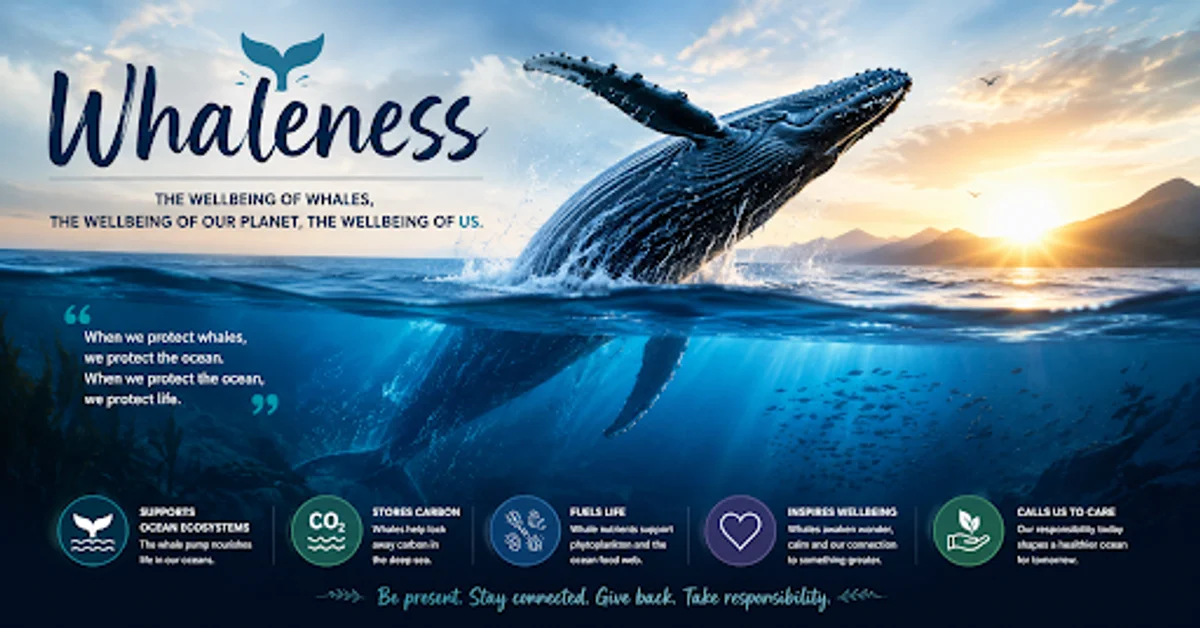
Whaleness: How Whales Support People and the Planet
Whaleness is a modern concept that connects whale conservation, ocean health, and human wellbeing. Instead, it is a fresh philosophy that uses whales as a powerful symbol of balance, connection, and care. The idea works because whales are real ecological actors, not just inspiring images. They are cetaceans, and NOAA notes that whales live in every ocean and include baleen and toothed species.
Whaleness also works as a mindset. It asks a deeper question than “What are whales?” It asks, “What can whales teach us about living well with the ocean?” That shift matters. It opens the door to whale-inspired wellbeing, ocean conservation, and a more thoughtful relationship with marine life.
Whales already capture public imagination because they are huge, social, intelligent, and often mysterious. Blue whales are the largest animals ever known, and NOAA reminds us that cetaceans include whales, dolphins, and porpoises across a wide range of species. Public interest grows even more when people learn that whales are not only beautiful, but also useful to the ocean’s health.
The Whaleness concept is gaining attention because it connects science with feeling. It speaks to whale ecology, ocean health, marine biodiversity, and the human need for awe. That mix is powerful. It turns conservation from a distant topic into something personal, hopeful, and worth protecting.
Also Read: Asbestlint: Hidden Risks Every Homeowner Should Know
The Origin of the Whaleness Movement
Julia Graeter and we.are.tohorā
The Whaleness movement is most clearly associated with Julia Graeter, whom we.are.tohorā identifies as the founder, visionary, and thought leader behind the idea. On the organization’s Whaleness page, the concept is presented as a new paradigm shaped by whale wisdom, science, creativity, and activism. That gives Whaleness a clear home and a clear voice.
This matters for trust. A concept becomes easier to understand when readers know where it comes from. In this case, Whaleness is not anonymous internet language. It is a named movement with a mission: to encourage respect for whales, the ocean, and the habits that support a healthier world.
Whaleness vs. Traditional Wellness
Traditional wellness usually focuses on the individual: health, stress reduction, balance, and lifestyle. Whaleness expands that frame. It keeps the personal side, but adds a wider ocean view. It says that human wellbeing is tied to marine ecosystems, wildlife protection, and climate awareness. That makes it a more collective and ecological idea than ordinary wellness.
This difference is what gives Whaleness its energy. It is not just “feel better.” It is “feel connected, then act responsibly.” That is a strong message in an era shaped by climate change, biodiversity loss, and growing interest in nature-connected living.
Why Whales Matter to Marine Ecosystems
The Ecological Role of Whales
Whales are more than iconic animals. NOAA describes them as some of the largest and oldest animals on Earth, present in every ocean and central to the cetacean family. Their importance lies in the way they move, feed, migrate, and interact with the sea. Species such as the Blue Whale, Humpback Whale, Fin Whale, Gray Whale, Right Whale, Sperm Whale, and Orca help shape public understanding of marine life.
The Whaleness idea fits here because whales are part of healthy ecosystems, not separate from them. They belong inside the larger picture of marine ecosystems, ecological balance, and ecosystem services. When whales thrive, the ocean often becomes easier to understand as a living system, not just a place of scenery.
The Whale Pump and Nutrient Cycling
One of the most important scientific ideas tied to Whaleness is the whale pump. IWC material explains that whales move nutrients through the water column through feeding, surfacing, and waste release. Those nutrients can support phytoplankton growth near the surface and strengthen nutrient cycling in marine food webs.
This is a beautiful example of how whales support life in quiet, invisible ways. Their role is not dramatic in the Hollywood sense. It is deeper than that. They help sustain the conditions that support marine biodiversity, ocean biodiversity, and the broader health of the sea. That is one reason Whaleness feels so compelling: it turns a natural process into a meaningful lesson.
How Whales Support Climate and Ocean Health
Carbon Storage in Whale Bodies
Whales can also contribute to carbon sequestration and carbon storage. NOAA explains that whales may help mitigate climate impacts by storing carbon in their bodies and transporting nutrients that support ocean food chains. The IWC likewise treats whale carbon and ecosystem function as important areas of research, while noting that the exact global value of these services still needs careful study.
That caution matters. Good science is precise, not exaggerated. It is fair to say whales are part of the ocean carbon cycle and contribute to climate-relevant processes. It is not fair to turn that into oversimplified magic. Whaleness is strongest when it respects both wonder and evidence.
Supporting Phytoplankton and Biodiversity
Whales help support phytoplankton, and phytoplankton matter enormously. They sit near the base of ocean food webs and play a major role in oxygen production and carbon movement. WWF describes whales as “nature champions” because of the way they cycle nutrients, support phytoplankton, and store carbon through life and migration.
This is where Whaleness becomes bigger than a slogan. It becomes a reminder that healthy whales often point to healthy seas. When whales help support plankton, they also help support ocean health, climate resilience, and the long-term stability of sustainable oceans.
Whaleness and Human Wellbeing
The Emotional Connection Between Humans and Whales
People respond to whales with awe for a reason. Whales are vast, graceful, and deeply social. ORCA’s public conservation work and we.are.tohorā’s experiences both show how whales can draw people into a stronger relationship with the sea. That emotional bridge is one of the clearest parts of Whaleness.
This does not mean whales are a cure for stress or sadness. It means they can support a richer nature connection. Many people feel more present, grounded, and hopeful when they spend time near the ocean or learn about marine life with care. That feeling is a real part of whale-inspired wellbeing.
Whale Sounds, Mindfulness, and Nature
Whaleness also touches mindfulness in nature. The idea is not that whale sounds replace mental-health care. It is that natural experiences, including guided ocean sound journeys, can create a calmer frame of mind. We.are.tohorā even offers a whale sound journey that blends science, creativity, and reflective experience.
That makes the concept feel fresh and practical. A person does not need to cross an ocean to feel closer to whales. They can listen, learn, slow down, and reconnect with the living world around them. In Whaleness, stillness is not passive. It is a form of attention.
The Four Core Principles of Whaleness
Presence and Connection
Presence is one of the strongest ideas behind Whaleness. Whales move through the ocean with purpose, and that movement invites people to do the same in life: slow down, pay attention, and notice what is already here. That is a simple message, but it is powerful.
Connection is the second principle. Whales are linked to food chains, migration routes, ocean currents, and marine habitats. They remind us that life is interdependent. In that sense, Whaleness is really a lesson in relationship: between people and whales, and between people and the planet.
Reciprocity and Responsibility
Reciprocity means giving back. If humans benefit from healthy oceans, then humans also have a duty to protect them. That includes supporting marine conservation, reducing waste, respecting wildlife, and choosing conservation-minded behavior. The idea is hopeful because it is actionable.
Responsibility is what keeps Whaleness honest. Admiring whales is not enough. The concept becomes meaningful when admiration turns into stewardship, education, and better choices. That is the bridge between inspiration and impact.
Is Whaleness Based on Science?
Scientific Evidence Supporting the Concept
Part of Whaleness is supported by solid science. NOAA, WWF, and the IWC all describe whales as important to ocean systems through nutrient movement, carbon storage, food-web support, and ecosystem function. These are real, measurable processes connected to ocean science and environmental stewardship.
The IWC also notes that climate change affects cetaceans directly and indirectly through prey, habitat, food webs, and ecosystems. That makes whale protection part of a broader conservation conversation. Whaleness is strongest when it respects this science and avoids easy exaggeration.
Philosophy vs. Scientific Research
Whaleness is not a formal scientific theory. It is better understood as a philosophy built on science. The ecological claims can be studied. The symbolic meanings—calm, unity, wonder, balance—belong more to human interpretation. Both can exist together without conflict.
That balance is important for trust. Readers should know what evidence is, what interpretation is, and what inspiration is. Whaleness does that well when it stays clear, honest, and rooted in verified marine conservation knowledge.
How to Practice Whaleness in Everyday Life
Responsible Whale Watching
A practical Whaleness mindset starts with respect. The IWC’s Whale Watching Handbook explains that responsible whale watching uses guidance on distance, speed, approach angle, and time near animals. The goal is simple: let the whales decide how close they want to be.
That is a good standard for responsible tourism. Watch, learn, and protect. Do not chase, touch, or disturb wild whales. Choose operators that follow local rules, because whale watching should support marine wildlife rather than stress it.
Simple Ways to Support Ocean Conservation
Whaleness does not require a boat trip. People can support ocean conservation by learning about cetaceans, reducing plastic waste, respecting beach and coastal habitats, and sharing accurate information. They can also follow trusted organizations such as NOAA, IWC, IUCN, WWF, ORCA, and we.are.tohorā for education and action ideas.
The United Nations Ocean Decade adds a larger frame to this effort. It is a global initiative running from 2021 to 2030 to advance ocean science for sustainable development. In that context, Whaleness fits neatly as a public-facing idea that encourages care, knowledge, and ocean restoration.
Threats Facing Whales Today
Human Activities Affecting Whale Populations
Despite their power, whales face real danger. The IWC lists bycatch, entanglement, ship strikes, ocean noise, pollution, debris, and climate change among its major conservation concerns. NOAA also points to the need to protect whales and their habitats. These pressures affect coastal ecosystems, migration routes, feeding grounds, and survival.
This is why Whaleness matters now. A concept about whales should not stop at admiration. It should lead to wildlife conservation and a deeper sense of urgency. Protecting whales is part of protecting the ocean system they help sustain.
Why Whale Conservation Matters
Whale conservation protects more than individual animals. It supports marine life protection, biodiversity conservation, and the health of the entire ocean web. IUCN’s cetacean work and Red List assessments help show how conservation decisions are tied to species status and risk.
That is why whale protection has both moral and practical value. A healthy whale population can mean healthier food webs, stronger ecosystem services, and a richer future for ocean life. Whaleness gives that reality a name people can remember.
Also Read: Uncuymaza: Why Everyone is Talking about It
Frequently Asked Questions
What is Whaleness in simple words?
Whaleness is the idea that whales support the planet’s wellbeing and can inspire human wellbeing through awe, connection, and respect for nature. It is a philosophy, not a formal scientific theory.
Who created the Whaleness concept?
It is associated with Julia Graeter and we.are.tohorā, which present her as the visionary and thought leader behind the movement.
Is Whaleness the same as wellness?
No. Wellness usually focuses on the person. Whaleness adds whales, ocean health, conservation, and nature connection to the picture.
How do whales help the environment?
They help move nutrients, support phytoplankton, store carbon, and contribute to healthy marine ecosystems. Scientists still study the full scale of these effects.
Can people safely watch whales?
Yes, when they follow local rules, maintain proper distance, and avoid disturbing the animals. The IWC offers guidance for responsible whale watching.
Summary
Whaleness works because it is simple, positive, and meaningful. It connects the science of whales with the feeling of being part of something larger. It also reminds us that the ocean is not separate from life on land. Healthy whales, healthy seas, and healthy communities belong together.
That message echoes the legacy of ocean-minded voices like Rachel Carson, Jacques Cousteau, and Sylvia Earle, who helped people see the sea as a living system worth protecting. Today, that spirit continues through groups like we. are.tohorā, ORCA, NOAA, IWC, IUCN, WWF, and the United Nations Ocean Decade. Whaleness gives that shared mission a fresh, hopeful language.
In the end, the message is bright: when people protect whales, they also protect the ocean system that supports biodiversity, climate resilience, and a deeper sense of human connection with nature. That is the real promise of Whaleness.